
Quantum Computing : Double Slit Experiment
This post is about the Double Slit Experiment.
Dr. Prateek Thapar
8/2/20242 min read
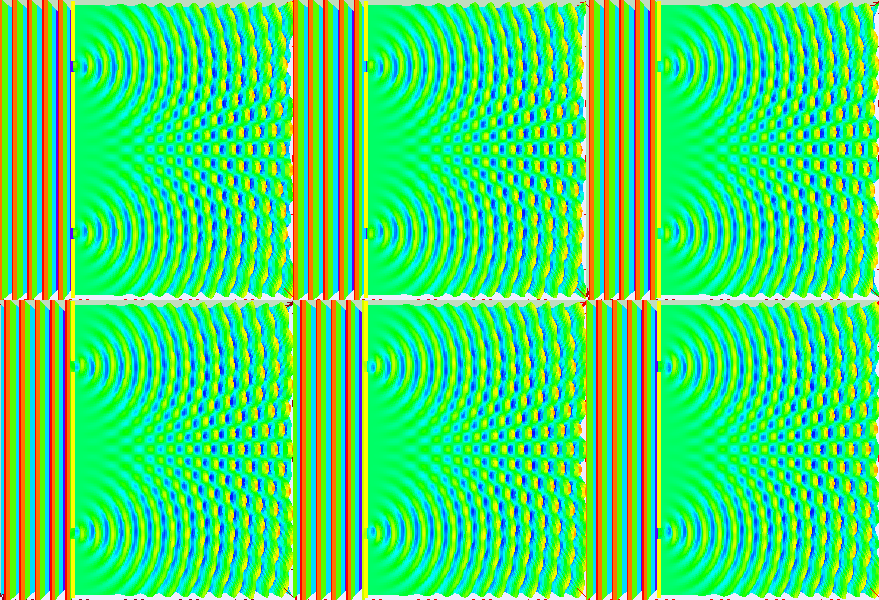
The double-slit experiment is a classic experiment in quantum mechanics that demonstrates the wave-particle duality of matter and energy. It was first performed with light by Thomas Young in 1801 to demonstrate the wave nature of light, but it has since been conducted with electrons, atoms, and even larger molecules, showing that the principles of quantum mechanics apply to particles of various sizes.
In its simplest form, the double-slit experiment involves a barrier with two narrow slits, a screen placed behind the barrier to detect the particles or waves, and a source that emits the particles or waves.
When particles such as photons or electrons are sent through the slits one at a time, and their arrival is recorded on the screen, they create an interference pattern, similar to the pattern produced by overlapping waves. This interference pattern consists of alternating bright and dark bands, indicating regions where the particles are more likely to arrive (bright bands) and regions where they are less likely to arrive (dark bands).
When particles are fired individually, they behave like discrete particles, creating two distinct bands of hits on the screen, aligned with the positions of the two slits. However, when a large number of particles are fired one at a time, an interference pattern emerges on the screen, resembling the pattern created by waves interfering with each other.
This interference pattern occurs because each particle behaves like a wave that passes through both slits simultaneously and interferes with itself. The wave nature of the particles causes them to interfere constructively in some regions, where the peaks of the waves coincide, and destructively in others, where the peaks of one wave align with the troughs of another, resulting in the observed pattern.
However, when a detector is placed at one of the slits to determine which slit the particle passes through, the interference pattern disappears, and the particles behave more like classical particles, with each one passing through one of the slits and striking the screen behind the barrier in a manner consistent with classical expectations.
This experiment illustrates the fundamental principle of wave-particle duality, where particles exhibit both particle-like and wave-like behavior depending on the conditions of the experiment. It also highlights the role of measurement in quantum mechanics, as the act of observing or measuring the particles affects their behavior. The double-slit experiment continues to be a cornerstone of quantum mechanics and has profound implications for our understanding of the nature of reality at the quantum level.